
Same-Day Dentures vs. All-on-4 Implants: How to Know Which One Is Right for You
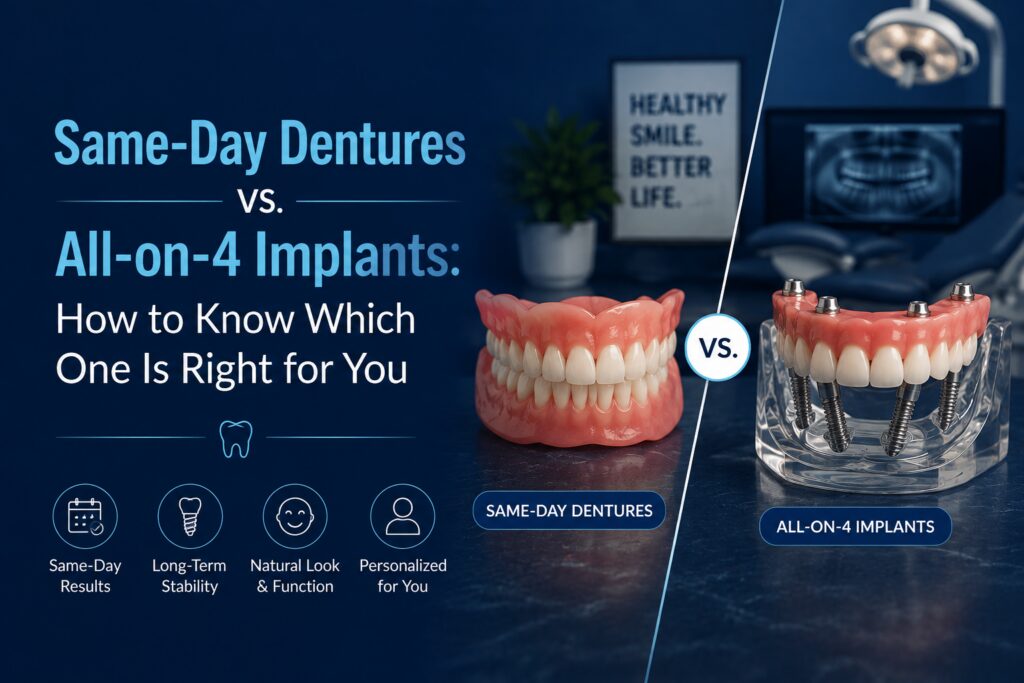
If you are missing most or all of your teeth, you have probably run into two names over and over again: same-day dentures and All-on-4 implants. Both promise a full smile in a single visit. Both are permanent-feeling solutions to a problem that traditional dentures never quite solve. And both are offered right here at Lush Dental & Implants in Hudson Oaks, TX.
But they are not the same treatment, they do not cost the same amount, and they are not right for the same person. If you have spent any time searching for answers, you have probably noticed that most explanations either oversimplify the difference or bury it in technical language that does not actually help you decide. This article is here to fix that.
What same-day dentures actually are
Same-day dentures, sometimes called immediate dentures, are a full or partial set of replacement teeth that you receive on the same day your natural teeth are removed. Instead of leaving the office with empty gums and waiting weeks for a denture to be made, you walk out with a functional, natural-looking smile immediately after extraction.
Here is how the process typically works. Before your extraction day, our team takes impressions, measurements, and digital x-rays of your existing teeth and bite. This information is used to fabricate your denture in advance, so it is ready the moment your teeth come out. On the day of your appointment, any remaining teeth are extracted, and your prepared denture is placed right away. You leave with teeth the same day, which is exactly why patients who have been avoiding the dentist for years, sometimes for a decade or more, tend to gravitate toward this option first.
Same-day dentures rest on the gums rather than being anchored into the jawbone. Some patients pair them with a small number of implants later on for extra stability, but in their most basic form, they are removable, much like traditional dentures, just delivered on a much faster timeline.
What All-on-4 implants actually are
All-on-4 is a different kind of solution entirely. Instead of a denture that sits on top of your gums, four strategically placed implants are anchored directly into your jawbone, and a full arch of replacement teeth is attached to those four implants. The angling of the implants is what makes this approach work with as few as four posts per arch, even in patients who have experienced some bone loss.
Because the teeth are fixed to implants rather than resting on the gums, All-on-4 does not shift, click, or need to be removed for cleaning the way a denture does. Depending on your case and how your jawbone heals, temporary teeth can often be attached the same day as implant placement, with a final, more refined set of teeth following once healing is complete.
All-on-4 is a surgical procedure with a longer overall timeline than same-day dentures, but it is also designed to function and feel much closer to natural teeth, both in day-to-day use and over the years that follow.
The real differences that matter to you
Stability and daily function
This is usually the deciding factor for most patients. Same-day dentures rest on the gum ridge, which means they can loosen over time as your jawbone naturally reshapes itself after tooth loss. Many denture wearers eventually deal with some slipping, a need for adhesive, or trouble with certain foods like corn on the cob or steak. All-on-4 implants are fixed in the bone, so they do not move when you eat, laugh, or speak. If your biggest frustration with dentures has been the fear of them shifting at the wrong moment, that is the exact problem All-on-4 was designed to solve.
Bone health
Your jawbone needs stimulation from tooth roots to maintain its density. Once teeth are gone, the bone beneath a denture continues to shrink gradually over the years, which is part of why dentures often need to be relined or replaced down the road, and why a denture that fit well in year one can feel loose by year five. Implants, because they are placed directly into the bone, provide that ongoing stimulation and help preserve the jaw’s shape and density over time.
Timeline
Same-day dentures have the edge here. You can go from a mouth full of failing or missing teeth to a complete smile in a single appointment. All-on-4 typically involves an initial surgical visit, a healing period, and a follow-up visit for your final set of teeth. Healing time varies from patient to patient, but it is a longer overall journey than same-day dentures.
Maintenance
Dentures come out for cleaning every night and need periodic relines as your gums and bone change shape. All-on-4 implants are cared for much like natural teeth, with brushing, flossing, and regular checkups, and they do not require the nightly removal routine that comes with a denture.
Candidacy
Same-day dentures are an option for nearly anyone who needs a full arch replaced, including patients with significant bone loss who may not yet qualify for implants. All-on-4 requires enough healthy jawbone to support the implants, though the angled placement used in this technique often allows patients to avoid bone grafting who might have needed it for traditional implant methods. A consultation with digital x-rays is the only way to know for certain which category you fall into.
What recovery looks like for each
Recovery is another piece patients often want to understand before committing to either path, and it looks different for each option.
With same-day dentures, the extraction itself is the main event. Depending on how many teeth need to come out and whether any of them require a surgical extraction, you can expect some swelling and soreness for the first several days, managed with over-the-counter pain relief or a prescription if needed. Because the denture is placed immediately, it also acts as a kind of bandage over the extraction sites, which many patients find more comfortable than they expected. The gums and jawbone continue to change shape during the following months as everything heals, which is exactly why a reline is usually needed once that initial healing settles.
With All-on-4, recovery involves both the extraction of remaining teeth, if any, and the placement of the implants themselves. Swelling, mild bruising, and soreness in the days that follow are normal, and most patients manage this with prescribed medication and a soft food diet for a period of time while the surgical sites heal. The implants then need a period of osseointegration, the process where bone fuses to the titanium post, before they can support the final, permanent set of teeth. Temporary teeth are typically worn during this stretch, so you are not without a smile while healing takes place. The exact timeline depends on your individual bone density and healing response, which is something we assess directly during your consultation and follow-up visits.
Neither recovery process is something to fear on its own. Nitrous oxide and other sedation options are available throughout, and the team at Lush Dental & Implants works specifically with patients who have avoided dental care for years due to anxiety or a difficult past experience elsewhere.
So which one costs less over 10 years?
This is the question most articles skip, and it is usually the one that matters most once the initial sticker shock wears off.
Same-day dentures typically have a lower upfront cost than All-on-4. That is part of why they are such a popular starting point for patients who need teeth removed quickly and are working within a tighter budget. But the ongoing costs are where the math shifts. Because the jawbone continues to change shape after tooth loss, dentures generally need to be relined every couple of years to keep fitting properly, and a full replacement denture is often needed somewhere in the range of every 5 to 10 years as the bone ridge changes further. Adhesive, cleaning supplies, and the occasional repair add smaller costs on top of that over time.
All-on-4 costs more upfront because it involves surgical implant placement along with the final prosthesis. That said, once the implants are integrated into the bone, they are built to last for decades with proper care, and the attached teeth typically do not need the same cycle of relines and replacements that a denture requires. Fewer follow-up procedures over the years can close much of the gap between the two options by the time you reach the 10-year mark, and for many patients the total cost of ownership ends up closer than the initial quote would suggest.
The honest answer is that the lower-cost option in year one is not always the lower-cost option in year ten, and the right call depends on your bone health, your budget today versus your budget over time, and how much you value not having to think about relines and adjustments down the road. This is exactly the kind of comparison worth working through at a consultation, where we can look at your specific bone structure, your current teeth, and your goals before giving you real numbers instead of a general estimate.
Which one is right for you?
A few honest questions can help point you in the right direction before you even sit down for a consultation.
Are you looking for the fastest possible path to a full smile, especially if you have been putting off dental care for a long time? Same-day dentures may be the more comfortable starting point, both financially and emotionally.
Do you want a solution that functions as closely as possible to natural teeth, without the daily removal, cleaning, and adjustment routine? All-on-4 is built around exactly that kind of permanence.
Has a dentist mentioned bone loss in your jaw during a past visit? That does not rule out All-on-4, but it does mean your candidacy needs a closer look with current imaging.
Are you weighing cost over the next year, or cost over the next decade? Both options have a place, but they answer that question differently.
There is no wrong choice here, only the choice that fits your mouth, your timeline, and your budget. What matters most is getting an honest look at your own bone structure and oral health before deciding, rather than picking based on price alone.
If you have been putting off this decision because you are not sure where to start, that hesitation is normal. Many of our patients come to us after years of avoiding the dentist, sometimes because of past pain, sometimes because of anxiety, and sometimes simply because they were not sure what their options even were. A consultation at Lush Dental & Implants includes digital x-rays and an honest conversation about what your jawbone can support, what each option would look like for your specific case, and what the real costs look like both now and years down the road. Sedation options are also available for patients who feel nervous about the process, so fear of the appointment itself does not have to be the reason you keep waiting.